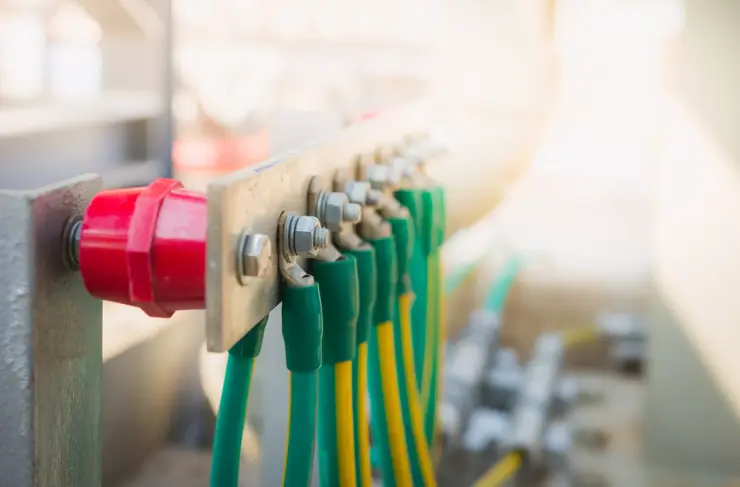
The terms “grounding” and “bonding” are often confused or misused (e.g., connecting a lug or piece of metal to a data center rack is often thought of as “grounding” the system however, that process actually “bonds” the system).
Grounding vs Bonding
Simplistically put, grounding (typically handled by electricians) involves creating an electrical connection to earth ground—essentially, a copper pole driven into the ground enabling electrical utilities to connect to it.
Bonding involves connecting to that grounding system and equalizes the ground potential of equipment eliminating static discharge between devices.
In a successful grounding and bonding system, electromagnetic interference noise is carried to ground along a shield to protect data from being impacted by noise during transmission. Any metal component of the networking or data center infrastructure should be bonded to the grounding system.
Determining who is responsible for installing a grounding and bonding system can be tricky. Some believe integrators and other cabling installers have a responsibility to recognize and understand grounding and bonding systems while others believe the responsibility lies elsewhere (as bonding is done to a grounding system the low-voltage installer isn’t responsible for).
We believe it's important for all involved in cabling and connectivity to understand grounding and bonding however, professionals in the telecommunications industry should primarily be focused on ensuring proper bonding.
How Bonding Works
The following summary covers a bonding system in a multi-level building.
- The primary bonding busbar (PBB) is located on the lowest level of a building & is attached to the grounding system (installed by the electrician).
- From the PBB runs a telecommunications bonding backbone (TBB), essentially a thick-diameter copper wire running up through each floor of the building to reduce variation between telecom systems on different floors.
- Each floor of the building has a secondary bonding busbar (SBB) which runs continuously to connect all SBBs to the PBB on the lowest level.
- The cable shielding system attaches to the SBBs & TBBs in the grounding system.
- If the building has equipment running on each side, the same scenario holds true for the other side of the building.
ANSI/TIA-607-C (Generic Telecommunications Bonding and Grounding for Customer Premises) encourages planning, design and installation of telecommunications grounding and bonding systems in new buildings, renovations or retrofits. Belden bonds cable shields to ensure proper system performance. Additionally, the third prong on all Belden equipment is considered a ground (in scenarios where it has a good path to earth ground).
About the author
Ron Tellas
Sr. Solution Architect, Enterprise Solutions, Belden
Ron Tellas is a subject-matter expert in RF design and Electromagnetic Propagation and joined Belden in 2016 to help define the roadmap of technology and applications in the Smart Building. He now takes these experiences to incorporate systems, equipment and connectivity into network solutions. Ron represents Belden in several standards organizations, committees of the National Electrical Code and as a board member of the FMP Alliance. He has a master and bachelor degrees in electrical engineering, a master in business administration and the inventor of 17 US patents. Ron is a proud recipient of the 2024 Harry J. Pfister award for his outstanding and impactful contributions to the Telecommunications Industry.