Relatively new to the market, however, there are a few things you should know about Digital Electricity cable technology …
1. It Supports Long Transmission Distances
With a low mutual capacitance of <50 pF per foot to maintain power-transfer speed, reliable power and data transfer across extended reaches is possible. This makes it ideal for large venues like airport terminals, convention centers, high-rise hotels, hospitals, stadiums and office towers.
2. It Supplies Safe Power Transmission
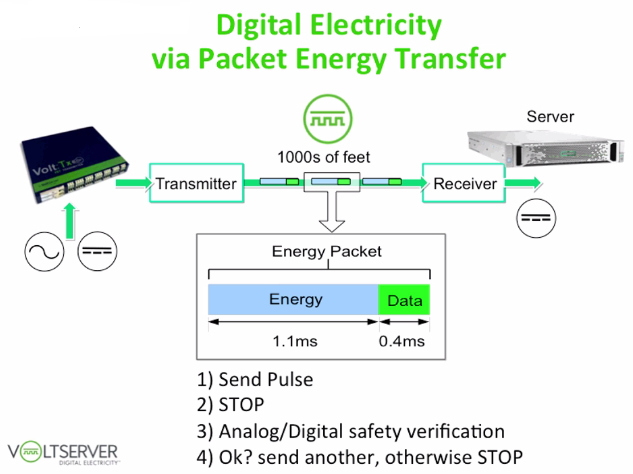
By transmitting “pulses” of DC power, Digital Electricity cables send energy and data across very long distances in a safe, efficient manner. Data-sensing transmitters and receivers are constantly monitoring line conditions to make sure power pulses are properly received.
If a problem is detected – like an exposed conductor being touched, or a wire being short circuited or incorrectly installed – power distribution stops immediately (within 0.003 seconds) to protect people and equipment. This makes the cable safe to touch, without the worry of dangerous electrical shock.
3. It Allows for Lower-Cost Networks
Even when transferring thousands of watts of power, Digital Electricity networks utilizing Digital Electricity cables can be installed at much lower costs than traditional networks. They don’t need conduit or armored cabling, and don’t require an electrician’s time. Instead, a cable installer can used for installation (similar to how a traditional PoE cable would be installed).
4. It Establishes Better Management and Control
Digital Electricity technology has inherent embedded data capabilities for energy management, monitoring and control. This means it can be used to remotely power and centrally back up systems like DAS remotes, mobile edge servers, PoE LED lighting systems and IoT sensors.
5. It Offers Installation Versatility and Flexibility
With a stranded design, Digital Electricity cable can maintain flexibility so performance isn’t impacted during installation. It can be used in indoor (plenum and riser), outdoor and overhead/burial applications.
In Belden’s Digital Electricity Cables, Digital Electricity technology is supplied by VoltServer. The transmitters and receivers are supplied by either VoltServer or JMA Wireless.
Digital Electricity cable is available in either copper or hybrid copper/fiber. Make sure you’re subscribed to receive our blog updates; we’ll talk more about this hybrid cable in an upcoming post – as well as more discussions on Digital Electricity cable as it becomes more prevalent.
About the author
Ron Tellas
Sr. Solution Architect, Enterprise Solutions, Belden
Ron Tellas is a subject-matter expert in RF design and Electromagnetic Propagation and joined Belden in 2016 to help define the roadmap of technology and applications in the Smart Building. He now takes these experiences to incorporate systems, equipment and connectivity into network solutions. Ron represents Belden in several standards organizations, committees of the National Electrical Code and as a board member of the FMP Alliance. He has a master and bachelor degrees in electrical engineering, a master in business administration and the inventor of 17 US patents. Ron is a proud recipient of the 2024 Harry J. Pfister award for his outstanding and impactful contributions to the Telecommunications Industry.