Related Tags
Let’s answer it here!
Unlike Category or Ethernet cables, which transmit data using electrical signals, fiber optic cables use fast-traveling pulses of light as a transmission medium. This signal-transmission process requires a transmitter, a receiver and glass as a way to transmit the light from the transmitter to the receiver.
The glass must be pure and clear so it can transmit light across long distances without losing information. To make this happen, certain materials are filtered out of the glass. From there, the glass rods are created and refined, and the glass is then heated and pulled to reduce the diameter into a thin optical fiber. There’s an entire manufacturing process dedicated to designing glass in different sizes for use in various applications (like fiber optic cable).
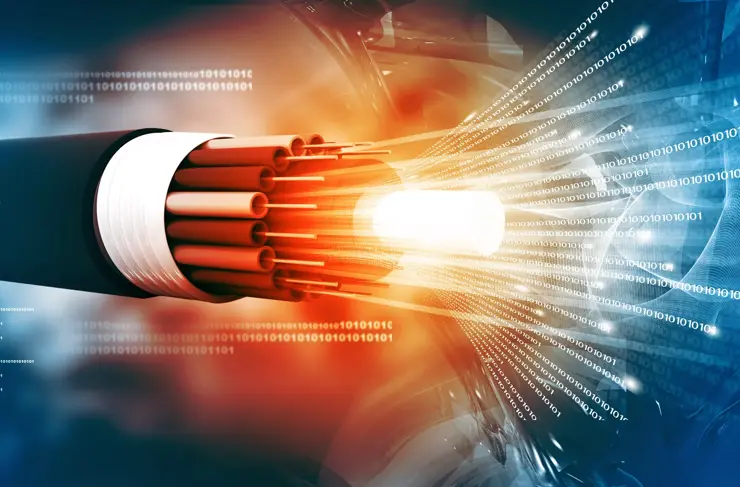
The resultant long, thin strands of glass are called optical fibers and are arranged in bundles inside a fiber optic cable. The single fibers are measured in microns, which represent one-millionth of one meter.
How Fiber Optic Cables Are Constructed
What components come together to make fiber optic cables work?
Core
First is the “core” or glass structure, which is how the light travels down the cable to a receiving device. As it travels, the light repeatedly bounces off the cable’s walls. The optical signal is propagated in the core through total internal reflection. The light is reflected at the interface between the core and cladding (which is the component we’ll discuss next).
The light signals are carried in paths that the light beam follows when traveling down the fiber. These paths are also called “modes.”
Cladding
Wrapped around the core is a thin layer of glass called “cladding.” It acts as a boundary that keeps light signals inside the cable. This allows data to travel through the entire length of the fiber to reach the receiver.
Coating
In many cases, you’ll find a layer of PVC or low-smoke PVC surrounding the cladding. Called the “coating,” this layer of plastic protects the core from being crushed or bent too far during installation. It doesn’t impact or influence the light traveling through the fiber—it simply provides protection.
Strength members
By giving strength to a cable during installation, strength members are made of steel, aramid fiber or a stiff fiberglass rod and enhance tensile strength. They help the fiber cable withstand pulling, bending, rolling, torsion and other forces.
Jacket
As the outer layer of the cable, the jacket acts as the cable’s first line of defense against its surrounding environment. Different jackets are available to protect against external factors like sharp objects.
How Each Fiber Cable Type Works
There are two types of fiber optic cable—singlemode and multimode—and each one of these fiber optic cables works a little differently.
Multimode fiber has a core that is size is five to six times larger in diameter than singlemode fiber (which we’ll discuss next).
Because of its core size, multimode fiber offers much greater light-gathering capacity. This means that “multiple modes,” or multiple light paths, can travel down that single fiber core at once. The bigger the core, the more light the cable can carry to achieve higher data transfer rates.
The multimode fiber types used in today’s projects, such as OM3, OM4 and OM5, are laser-optimized fiber, which means either an LED or VCSEL laser can be used as the light. With OM5—the newest type of multimode fiber—also comes a new technology, called shortwave wavelength division multiplexing, which allows multiple signals to be sent down the fiber at a single point in time, increasing transmission performance.
Singlemode fiber has a smaller core size than multimode fiber. As a result, it carries light directly down the fiber (it only allows the fundamental mode of light to transmit down the fiber). As a result, light reflection created during light transmission decreases, lowering attenuation and allowing the signal to successfully travel over longer distances. Singlemode fiber cable types include OS1 and OS2.
Instead of thinking of one type of fiber cable as “better” than the other, it’s best to think about them as two separate types created for different purposes.
Because multiple light paths travel down a multimode fiber cable, it only offers high bandwidth over a short distance.
In singlemode fiber, all light travels at about the same speed and arrives at roughly the same time, eliminating the effects of modal dispersion found in multimode fiber. This supports higher bandwidth levels with less signal loss over longer distances. This makes singlemode fiber ideal for long-haul signal transmission applications, such as across or between campuses, undersea or in remote offices.
Our team is here to help you make the right decisions about your fiber optic cable systems. If you have more questions about fiber cable, need help making the right choice or are looking for more detailed information about how fiber optic cable works, we’re happy to answer your questions.
Related Links:
https://www.belden.com/Blogs/Smart-Building/4-ways-integrators-are-impacted-by-fiber-demand https://www.belden.com/blogs/smart-building/5-unique-benefits-of-fiber-optic-cable/ https://www.belden.com/Blogs/optituff-mini-fiber-cable-for-hospitality-tech
Let’s answer that question here!
But first, let’s define what we mean by “fiber optic cable.” Fiber optic cable is defined by an optical fiber, strength members and outer jacket. The optical fiber transmits the signal, the strength member provides tensile and crush resistance, and the jacket protects the overall cable from the environment.
Unlike the copper used in Category or Ethernet cables, which transmit data using electrical signals, optical fiber uses glass as a transmission medium for fast-traveling pulses of light. The basic signal-transmission process requires a transmitter, a receiver and an optical fiber made of glass as a way to transmit the light from the transmitter to the receiver.
Optical fiber is manufactured using a two-step process. The first step consists of producing pure glass to create a preform. To make this happen, various doping gases are used to add layers of pure glass to a cylinder. The purity of the glass is critical so it can transmit light across long distances without losing information.
The second step is called “fiber draw.” Here, the preform is heated and pulled to reduce the diameter into a thin optical fiber. The size of a standard optical fiber is 250 microns. For size reference, a human hair is about 100 microns. This process is similar how confectionaries make tiny designs with their hand-rolled candies—except the large glass cylinder is heated to its melting point and pulled, not rolled, to get the desired geometries.
The resultant optical fibers are arranged in bundles with strength members and/or buffer materials inside an outer jacket.
How Fiber Optic Cables Are Constructed
What components come together to make fiber optic cables work?
Optical fiber is composed of a core, a cladding and a coating. These are called the “three Cs.”
Core
First is the “core” or glass structure, which is how the light travels down the cable to a receiving device. As it travels, the optical signal is propagated in the core through total internal reflection. The light is reflected at the interface between the core and cladding (which is the component we’ll discuss next).The light signals are carried in paths that the light beam follows when traveling down the fiber. These paths are also called “modes.”
Cladding
Wrapped around the core is a thin layer of glass called “cladding.” It acts as a boundary that keeps light signals inside the core. Think of this as a perfectly reflecting mirror surface. This allows data to travel through the entire length of the fiber to reach the receiver.
Coating
In many cases, two UV-cured coating layers are applied on the top of the cladding. Called the “coating,” this dual layer protects the glass from scratch, microscopic bending, and contaminants. Fibers are glass, and this extremely thin and fragile material requires these protective materials to survive both manufacturing and end-user handling.The overall cable construction then packages the optical fiber to meet requirements, which vary based on applications and regions.
Fiber optic cables also include two other components:
Strength members
To give strength to a cable during installation, materials such as steel, aramid fiber, fiberglass yarn or a stiff fiberglass rod are used to enhance tensile strength and crush resistance. They help the fiber optic cable withstand pulling, bending, rolling, torsion and other forces.
Jacket
As the outer layer of the cable, the jacket acts as the cable’s first line of defense against its surrounding environment. Different jackets are available to protect against external factors like sharp objects. These can also be flame-retardant in nature, depending on the application, such as indoor risers or air plenums.
How Each Fiber Cable Type Works
There are two types of fiber optic cable: singlemode and multimode—and each one of these optical fibers work a little differently.
Multimode fiber has a core that is size is five to six times larger in diameter than singlemode fiber (which we’ll discuss next).
Because of its core size, multimode fiber offers much greater light-gathering capacity. This means that “multiple modes,” or multiple light paths, can travel down that single fiber core at once. The bigger the core, the easier it is to couple light into the fiber to transmit data.
The multimode fiber types used in today’s projects, such as OM3, OM4 and OM5, are laser-optimized fiber, which means either an LED or VCSEL laser can be used as the light to achieve higher data rates. With OM5—the newest type of multimode fiber—also comes a new technology, called short wavelength division multiplexing, which allows multiple signals to be sent down the fiber at a single point in time, increasing transmission performance. Think of this as having four individual laser channels in the same fiber, which can operate independently.
Singlemode fiber has a smaller core size than multimode fiber. As a result, it carries light directly down the fiber (it only allows the fundamental mode of light to transmit down the fiber). Light reflection created during light transmission decreases, lowering attenuation and allowing the signal to successfully travel over longer distances. Singlemode fiber cable types include OS1 and OS2.
Instead of thinking of one type of an optical fiber as “better” than the other, it’s best to think about them as two separate types created for different purposes.
Because multiple light paths travel down a multimode fiber, it only offers high bandwidth over a short distance. These different modes travel down the fiber at different speeds and arrive at the detector slightly skewed from each other. Think of it like an echo chamber: the more modes you have, the longer the echo is. It makes it more difficult to understand where words start and end as they begin to blur into each other.
In singlemode fiber, all light travels at about the same speed and arrives at roughly the same time, eliminating the effects of modal dispersion found in multimode fiber. This supports higher bandwidth levels with less signal loss over longer distances, which makes singlemode fiber ideal for long-haul signal transmission applications, such as across or between campuses, undersea or in remote offices.
Our team is here to help you make the right decisions about your fiber optic cable systems. If you have more questions about fiber optic cable, need help making the right choice or are looking for more detailed information about how fiber optic cable works, we’re happy to answer your questions.
Related Links:
4 Ways Integrators Are Impacted by the Increase in Fiber Demand
About the author
Jim Zimnicki
Senior Product Development Engineer, Fiber
Jim Zimnicki worked with Belden for more than seven years in cable manufacturing, engineering and product development. After serving as an intern at Belden, he joined the team full time in August 2017. As a former product development engineer and senior product development engineer, Jim oversaw designs to meet customer and new business criteria, assessed test data for standards compliance and supported Belden manufacturing trials. He holds a Bachelor of Electrical Engineering and a Master of Science in Electro-Optics from University of Dayton.