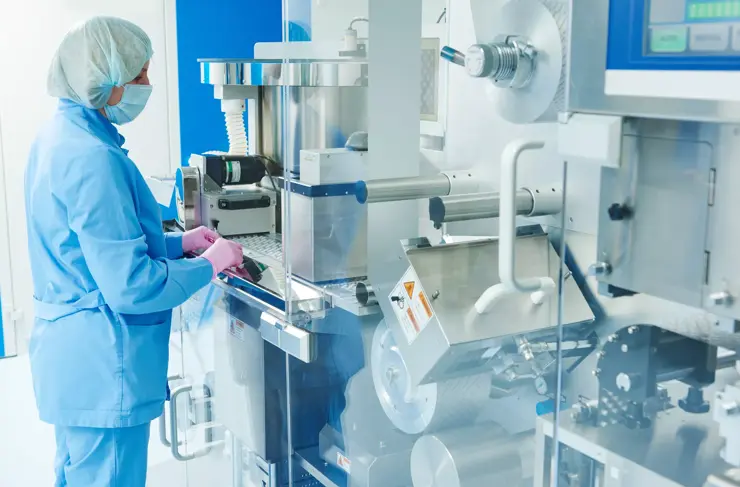
On too many high-volume pharma lines in life sciences manufacturing right now, the story of day-to-day production reality is painfully similar: There’s a visibility problem.
Aging equipment runs reliably enough that no one wants to touch it. To keep up with demands, islands of sensors have been wired in over the years. Operators walk the floor with clipboards to collect readings because there’s no single system of record they can trust to capture, contextualize and retain data.
In life sciences manufacturing, production lines like these are running far below their potential. Ad-hoc efforts deliver poor performance, only partial visibility and weak traceability. According to OEE (overall equipment effectiveness) benchmarking data from SCW.AI, for example, pharma line OEE hovers around 37%, while corporate targets sit closer to 60%.
At the same time, these manufacturers are under growing pressure to prove 21 CFR Part 11 and EU Annex 11 compliance with complete, auditable batch histories. To build the audit trail regulators expect, every critical data point, operator action and quality decision needs to be captured as a secure electronic record.
Visibility would change everything, but ripping and replacing equipment just to modernize isn’t an option. It’s too costly, too disruptive and too risky.
How can life sciences manufacturing improve pharma line OEE and capture compliant, real-time insight from lines that weren’t designed to be digital?
Why progress stalls on legacy lines
Executives, quality leaders and OT teams need answers to fundamental visibility and compliance questions before they can justify new investments or change how they run their lines.
But deep-rooted constraints stand in the way of progress.
3 constraints holding pharma lines back
1. Fragmented sensor data
Teams add sensors from different vendors, using different protocols and gateways. This leads to a patchwork of local HMIs, spreadsheets and partial connections to higher‑level systems.
Engineers know the data they need exists somewhere, but there’s no unified, trustworthy stream they can use to monitor the line in real-time.
2. Siloed quality processes
Quality teams may run periodic defect audits or pull sample data into separate systems, but those checks are rarely part of day‑to‑day production decisions. Why? Because the data isn’t integrated with production systems in a way that operators and supervisors can act on.
Targets exist at the plant or line level instead of being tied to specific processes or batches, so problems show up as aggregated metrics. This makes it hard to see where issues originate or how to correct them.
3. Weak track-and-trace capabilities
Legacy systems often provide basic production history, but they don’t capture every sensor reading, operator action or quality event. Those types of records are necessary to reconstruct a complete, compliant electronic record for any batch on demand.
As expectations around 21 CFR Part 11 and EU Annex 11 intensify, life sciences manufacturing teams need to find ways to capture electronically signed audit trails that regulators can trust … without creating more work for themselves.
Watch an existing pill bottling line become fully visible
If you can pull clean, contextualized data from legacy assets quickly and securely, you can turn that data into insight and compliant records almost immediately: That’s the premise behind what Belden CloudRail and Tulip have built together.
Let’s consider a scenario like pill bottling to understand what it could look like in practice.
Before: disconnected devices and manual checks
Fragmented sensor data. A series of disconnected IFM sensors monitors throughput, vibration and temperature across mixed industrial protocols. Each device does its job, but readings live in local HMIs and spreadsheets. There’s no unified view of how the line is performing right now.
Siloed quality checks. Operators inspect filled bottles visually and record issues on paper or in spreadsheets. Defect data lives separately from production data, so quality decisions happen after the fact. They’re disconnected from the sensor readings and operator actions that could explain them.
No usable audit trail. The line produces basic production history, but sensor readings, operator actions and quality events aren't captured together. Reconstructing a complete, compliant record for any given batch means pulling from multiple systems and filling in gaps by hand.
After: a connected, contextualized data stream
A unified data stream. Engineers connect IO-Link sensors and legacy devices to Tulip through CloudRail—no protocol mapping, no modifications to the machines themselves. Data arrives normalized, timestamped and ready to use. The patchwork of HMIs and spreadsheets becomes a single, trustworthy stream.
Integrated quality processes. Tulip’s operations platform turns data streams into no-code applications that live with the people closest to operations. Operational apps put real-time context in front of operators to guide inspections, surface anomalies and capture decisions as they happen. That way, those people can become the first line of defense against quality escapes. Process engineers author these apps themselves without IT backlog or vendor dependency. Quality data is tied to specific batches and processes, not just plant-level aggregates—so problems show up where they originate, with enough context to act on.
Complete track-and-trace capabilities. Tulip Tables record every sensor reading alongside batch information. Each operator action and quality event is captured as part of an electronically signed audit trail. Reconstructing a compliant electronic record for any batch becomes a query, not a project.
Real-time decisions. Once data is flowing, engineers can see pharma line OEE in real-time, with throughput and performance broken down by shift and product run. Automations send alerts when vibration levels suggest a potential mechanical issue or when throughput dips below a defined threshold.
The impact on pharma line OEE and compliance
Customers in similar environments have seen OEE improvements of between 10% and 20%, driven by:
- Faster detection of emerging issues
- Fewer defects thanks to real-time feedback
- Less time spent manually collecting and reconciling data
- More consistent execution of inspection and verification
- Quicker root-cause analysis
Behind each of these gains is an operator who now has the right information at the right moment, and a quality team that isn’t reconstructing batch history from spreadsheets after the fact. Compliance stops being a separate workstream. Audit trails are built into how the line runs, not assembled after the fact.
Achieve measurable gains across your plant
With Belden CloudRail and Tulip, life sciences manufacturing teams can digitize legacy lines quickly, lift pharma line OEE and meet compliance requirements. Tulip’s frontline operations platform is designed to sit at this intersection, connecting the signals from the floor to the people who need to act on them.
Because Belden CloudRail and Tulip are composable, what you build for pill bottling today becomes the foundation for digitizing your next line tomorrow ... without starting over. And while we use the example of pill bottling here, this combination can be replicated across entire CPG and manufacturing production environments, enabling:
- OEE improvements of 10% to 20%
- Defect reductions of 15% to 20%
- Throughput gains of 10% to 15%
If you’re planning your own IT/OT convergence initiative, there are several ways we can help you get started.
Reach out to discuss your specific environment and regulatory requirements.