1. Private 5G
Private 5G network cells can be deployed with less cabling and less downtime than access points require.
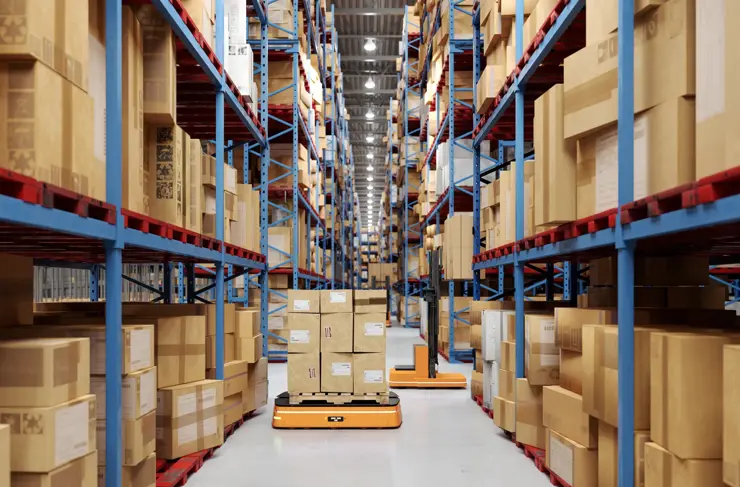
Some of the world’s most automated environments have long run on Wi‑Fi (and still do), layering in a few industrial upgrades to support new devices and applications as they roll out.
For years, Wi-Fi has been the obvious answer for warehousing, logistics and discrete environments as they built out foundations to support mobile tech like handheld scanners, tablets and even a few automated guided vehicles (AGVs).
At the time, it was also the wireless solution that made the most sense in terms of cost and ease of use.
However, as new applications stretch the limits of Wi-Fi’s capabilities, and industrial cellular matures, Wi-Fi being the default standard is changing. Cellular costs are coming down, while its ability to deliver stable, deterministic performance is going up. This makes 5G a realistic contender for operational workloads that once seemed appropriate only for Wi‑Fi.
Warehousing, logistics and discrete environments now have more options to support industrial wireless. As a result, they’re looking more critically at where Wi‑Fi still fits and where 5G may be a better long-term investment.
The two technologies are very different in terms of how they work, the architectures they rely on and the purposes they serve. Understanding these differences can help you match the right technology to the right application.
Wi-Fi is a mature, well-established technology that is widely deployed and understood across industries.
It was originally designed to support internet access over the air through one-to-one (point-to-point) communication between a device and access point. Its priority is convenience, not deterministic performance (the ability to deliver data within a tight, predictable window of time).
To professionals who have enterprise IT skills, managing industrial Wi-Fi is comfortable and familiar. It uses the same concepts, tools and processes as office networks (wireless Ethernet connections). This is one of the reasons it became the default choice in many industrial environments—and it may still be, depending on the situation. (For example, if your facility has a small number of wireless devices to connect, or if it occupies a small space, then Wi-Fi is probably the best option.)
Wi‑Fi networks allow wireless devices to connect to the network using unlicensed spectrum (shared frequency that anyone can use without buying a license). This keeps entry costs low, but it also makes interference harder to predict and control. Nearby Wi‑Fi networks and devices may compete for the same frequencies, which can create congestion and dropped connections.
As more wireless devices are added, performance issues become more likely. Every scanner, AGV, automated mobile robot (AMR), camera or sensor that joins the Wi‑Fi network is sharing the same bandwidth.
The nature of warehousing, logistics and discrete facilities can also create Wi-Fi coverage gaps and dead zones. For instance, these environments often include lots of metal and other materials that make it tough for wireless signals to penetrate. While good wireless design and ongoing optimization can sometimes keep these challenges at bay, Wi-Fi performance is pushed closer to its limits as it scales to support more time‑sensitive mobile devices.
Unlike Wi-Fi, cellular 5G was designed to deliver one-to-many communication. As a result, 5G can scale to predictably support high device density.
While cellular technology is technically sound, 5G is still evolving as industries experiment with, refine and standardize how to deploy it and take full advantage of its capabilities.
Instead of relying on wireless access points, 5G relies on a cellular architecture made up of a radio access network (small cells, macro cells, gNodeB cells) plus a core network that manages authentication, mobility, quality of service and network slicing capabilities.
These features allow it to offer deterministic performance in the 10- to 15-millisecond range, which is required for applications that can’t tolerate delays. Future releases and roadmaps for cellular technology target even better performance to align with real‑time control, motion and safety applications.
Because 5G operates in licensed or managed shared spectrum (frequency bands reserved for specific users or tightly coordinated so only approved networks can use it), interference is highly controlled.
It represents a fundamentally different approach to wireless networking: Think of it as a complete network system that can centralize control, authentication and service prioritization.
5G offers something that Wi-Fi can’t: the ability to combine wireless flexibility with deterministic performance.
This is critical as warehousing, logistics and discrete environments continue to add hundreds of devices and automation capabilities to improve operation, safety and visibility, including:
5G can handle this device density without the connectivity issues that appear when Wi-Fi networks get busier.
5G also offers unique security benefits. Devices typically connect using SIM or eSIM identities that are hard to copy. From the device to the core, traffic is encrypted and checked at every step.
With 5G, separate networks aren’t needed for each application. Many services can be run on a single 5G network, with infrastructure segmented based on area, type of service and/or type of machine. Plants could use one converged wireless layer to connect autonomous vehicles that send a few time‑critical messages, simple sensors that stream constant data, and everything in between, with each application getting the service level it needs. This is a major advantage as the number of connected devices grows.
Both Wi‑Fi and 5G can support IT‑OT convergence—a critical enabler for modern industrial operations—but they do it in different ways. Each establishes a different model to support IT-OT interaction.
With industrial Wi‑Fi, wireless typically sits on the OT side. Access points connect to OT switches beyond the IT firewalls. Mobile assets join the OT network just like any other field device.
With private 5G, the 5G core network can live closer to the IT environment. Instead of traversing a traditional OT network first, mobile devices connect to services hosted in the IT domain.
When deciding where Wi‑Fi is sufficient vs. where 5G’s performance and scalability are needed, it’s important to evaluate total cost of ownership.
For most manufacturers, industrial Wi‑Fi is a straightforward and cost-effective investment. Hardware, design and installation are paid for upfront, with no ongoing costs other than maintenance attention when it’s needed. Upfront costs for Wi-Fi are often lower than 5G.
But 5G offers other options.
Private 5G network cells can be deployed with less cabling and less downtime than access points require.
A subscription or usage‑based fee wraps hardware, software, lifecycle management, etc. into a monthly payment.
A facility can rely on third‑party infrastructure (a mobile operator’s network) for availability and coverage.
| Wi-Fi |
5G |
|
| Number of connected devices |
Small/moderate number of devices |
Large/growing numbers of connects assets and fleets |
| Device density |
Low to medium | High |
| Coverage area | Confined spaces; smaller facilities |
Large sites; extensive footprints |
| Communication | Non-critical traffic that can tolerate occasional delays |
Time-sensitive traffic |
| Investment | Low upfront infrastructure costs |
Higher upfront infrastructure costs |
| Maturity | Familiar/established technology |
Newer/still evolving technology |
Choosing between Wi‑Fi and 5G is about understanding what each part of your operation really needs. Belden’s deep OT experience and strong IT and cybersecurity expertise can help your team assess its warehouse, production lines and logistics flows to map wireless requirements to the most appropriate solutions.
By starting with a baseline assessment to understand your critical applications, device types, coverage needs and performance requirements, we can help you determine whether industrial Wi‑Fi, private 5G or a mix of both makes the most sense, as well as where each wireless solution should live inside your facility.
Once the direction is clear, Belden has complete connection solutions for every scenario to support you from concept to ongoing operation.
Learn how we can support your wireless projects.