To stay competitive and support rapid innovation, organizations need to move quickly. But traditional power delivery makes modern building upgrades slow and costly.
Traditional power delivery methods were never intended to keep up with the constant change and growth happening in today’s connected environments. Instead, they were designed around fixed endpoints and static wiring that don’t work for smart buildings supporting hundreds or thousands of networked devices.
Because of this gap, every new device deployed in a hotel, on the plant floor or in a workspace often requires workarounds to keep it connected to the network—and to a power source. These manual fixes cost valuable time and money, and they don’t scale as device counts grow.
Adding, managing and scaling power needs to be as straightforward as making a simple configuration change to an IT network.
To make this possible, it’s time to adopt a network-inspired approach to power distribution by applying a star topology.
What is a star topology?
For decades, the star topology model has made data networks resilient and manageable. It’s an architecture that IT professionals are very familiar with.
In a star topology, all devices and data connect to a single, central network hub (creating a “star” or hub-and-spoke setup).
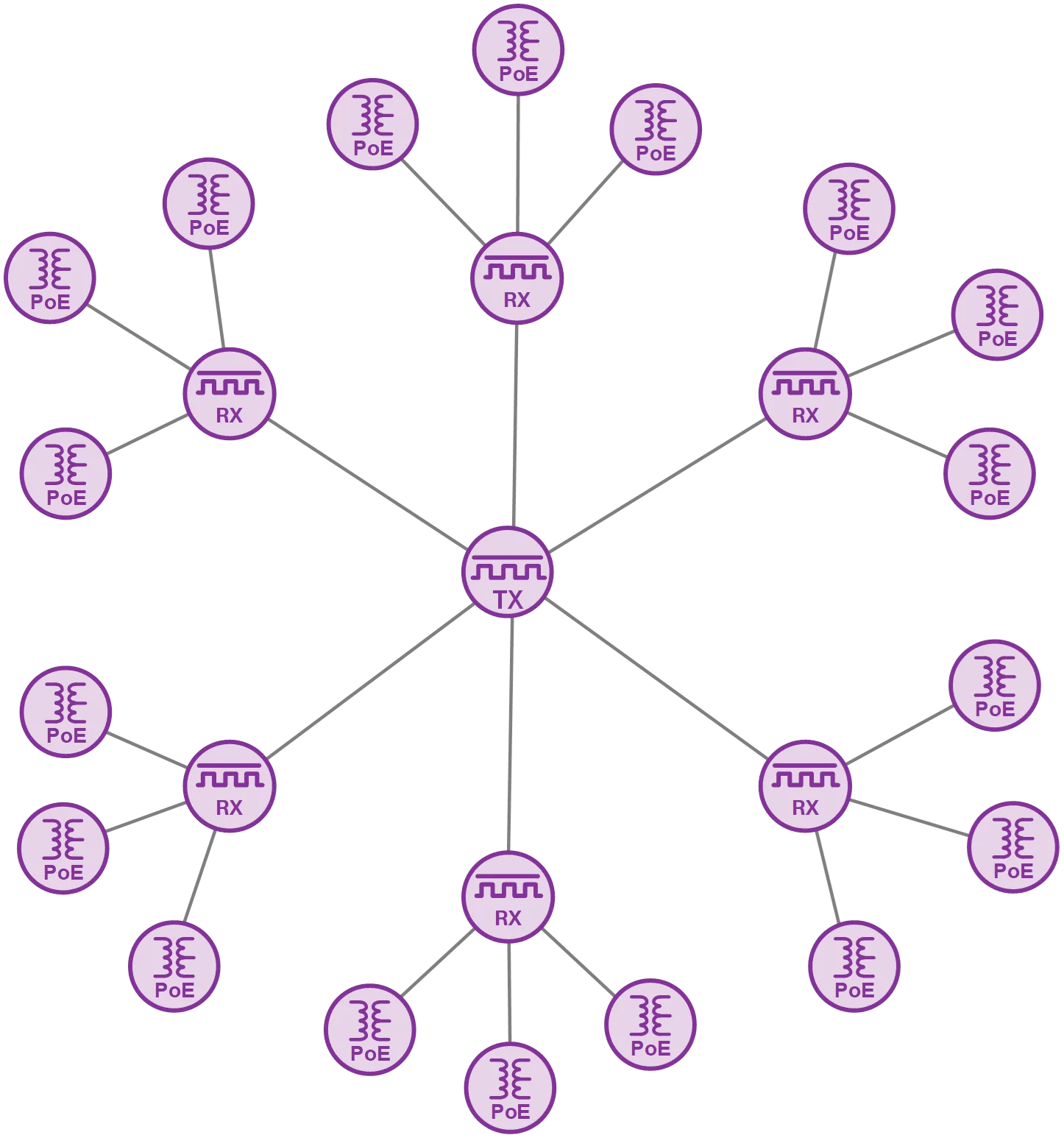
A star topology network configuration involves three layers, each with a specific function.
1. Core layer (central network backbone)
This layer serves as the centralized network core or “hub.” It provides high-speed, reliable data transmission between devices in the distribution layer.
2. Distribution layer (traffic aggregation and policy control)
This layer moves traffic from the access layer below it (devices and endpoints) to the core layer above it (the hub). Every branch (spoke) connects back to the core.
3. Access layer (endpoint connectivity)
This layer connects end-user devices (computers, printers, cameras, access points, etc.) to the network using switches and cabling.
What are the benefits of star topology in IT?
A star topology network configuration is the backbone of modern IT for several reasons.
- Easier MAC work: Adding, changing or removing devices is easy because technicians don’t need to reconfigure the entire system.
- Better troubleshooting: Individual devices and connections can be tested or replaced without disrupting the others.
- Improved uptime: Having backup power in one location provides easy maintenance and assurance.
- Streamlined management: Traffic and performance can be monitored from a single remote point, making it faster and easier to detect anomalies and failures.
This same topology can help reimagine power delivery. It offers facilities teams the simplicity, flexibility and control that IT teams rely on for networking. Just like a centralized network hub manages data traffic, a centralized power hub can manage power distribution.
A star topology for power delivery
Traditionally, ICT focuses on data and limited power. Star topology for power can change that, offering a new way to deploy and deliver centralized power for smarter, more connected spaces.
Star topology for power
Instead of distributing small amounts of power across many endpoints, star topology for power brings true electrical capabilities into the network infrastructure itself. It delivers power at scale, using the same cabling already in place for networking.
Power infrastructure can be organized into three hierarchical layers: core, distribution and access.
1. Core layer (central power source)
All power originates here at the “heart” of the system, within a secure, climate-controlled environment. Backup batteries, generators and centralized monitoring are managed in the core layer. This layer also supports the distribution layer; the power it pushes out to that layer is fault-managed power (FMP).
2. Distribution layer (intermediate power aggregation)
Flexible, scalable delivery of power is enabled here; it’s aggregated from the core layer to multiple access zones located across various parts of a building or campus. FMP is often used at the distribution layer to move significant power across long distances, supporting endpoints at the access layer. To support shorter distances, FMP can be converted to AC or DC to serve specific needs. For longer distances, it can be maintained as FMP.
3. Access layer (endpoint delivery)
This is where power reaches the edge. Individual devices are connected to power, whether it’s PoE, FMP or DC power. Electrical capacity is delivered to each endpoint through cabling, eliminating the need for separate power outlets.
Key benefits of star topology to support centralized power
Star topology can support greater power demands and more device types, all centrally managed. As more environments demand higher power—to support Wi-Fi 7 access points, for example—star topology provides the capacity and flexibility to deliver what’s needed.
When power delivery is centrally managed, monitored and automated in a protected location, critical systems are easier to support and control. With centralized management, it’s also possible to automate energy savings by turning off devices in areas that aren’t occupied, reducing energy waste and operating costs.
Unified cabling infrastructure
Another key benefit of star topology for power is using the same cabling infrastructure to carry data and increasingly higher levels of power along all layers (core, distribution and access). The same wiring method is used throughout the network to deliver not only data but also power, upending the traditional separation between power and IT networks.
Adding or moving devices is simple and requires only a single line to the central power hub, making it fast and economical to scale in connected spaces.
No switch limitations
With a star topology, power is no longer limited by a switch’s internal supply. You don’t need to replace switches just to add more high-power devices: The backbone already delivers enough power everywhere. To take advantage of it, you simply need to ensure that the correct cables and connectors are being used.
Simplified troubleshooting
Because each endpoint has its own connection, troubleshooting is straightforward. Issues can be isolated and repaired without impacting the rest of the system. A problem at a single point can be isolated and corrected to maximize network efficiency.
Support for any type of power
Finally, as mentioned earlier, star topology supports any power type, including:
- Fault-managed power (FMP): FMP represents a new way to safely send thousands of watts of power over communications cabling. Faults are detected and isolated quickly to protect devices and people. In a star topology, FMP is delivered from the core through the “spokes” (IDFs and cables) to many endpoints. It can address the massive amount of power needed between the core and distribution layers.
- AC or DC power: In a star topology, FMP is converted to the native power requirement of the equipment (either AC or DC power). It provides a uniform, efficient and centralized power source that can be widely distributed to devices.
- Power over Ethernet (PoE): End devices with PoE ports are used to connect devices under 100W, such as access points, VoIP phones or sensors. In a star topology, PoE is carried over the “spokes” or branches.
Converging power and data for smart environments
In the world of IT, power and data have traditionally traveled separate paths, run on separate networks and been maintained by separate teams. Applying a star topology to power changes that, bringing power and data together and allowing power to catch up to data in terms of reach and scalability.
Fault-managed power, or Class 4 power, eliminates the plateau of power delivery that has prevented high-capacity deployment. It opens up new possibilities to deliver robust power to wherever it’s needed. There are virtually no boundaries—no power supply problems to worry about.
This is the future of connected environments: the convergence of data and power, all managed, monitored and delivered on one unified architecture.
Learn more about fault-managed power.
Related resources:
About the author
Ron Tellas
Sr. Solution Architect, Enterprise Solutions, Belden
Ron Tellas is a subject-matter expert in RF design and Electromagnetic Propagation and joined Belden in 2016 to help define the roadmap of technology and applications in the Smart Building. He now takes these experiences to incorporate systems, equipment and connectivity into network solutions. Ron represents Belden in several standards organizations, committees of the National Electrical Code and as a board member of the FMP Alliance. He has a master and bachelor degrees in electrical engineering, a master in business administration and the inventor of 17 US patents. Ron is a proud recipient of the 2024 Harry J. Pfister award for his outstanding and impactful contributions to the Telecommunications Industry.